Sunday, July 31, 2011

Hiking around Mt St. Helens

Hello!


It's been a while since we posted anything (almost a year!), and we need to catch up. We just took a trip up to the Mt. St. Helens area (Coldwater Lake) and had a great hike. We also went up to Olympia for the night, then onto Enumclaw, WA for the Enumclaw Highland Games, but those will be in another post. This post will be about the Coldwater Ridge hike on 30-Jul-2011.


The start of the trail (below) let us know that we were going to see lots of wildflowers on this hike. Even the trail head was covered with lupine and other wildflowers.


The hike was almost a constant steady climb, with almost no dips from 2500 ft up to 3800 ft.. The first part is up a sparsely treed hill, with even more wildflowers. Most of the yellow flowers below are just dandelions.


We began to see lots of small trees with absolutely no leaves left, and they were covered with webs full of caterpillars. In this lower section of the hike, almost all of the trees were stripped of their leaves.


The caterpillars were even building their webs in the ground plants, like the lupines and grasses.


They were everywhere! You couldn't walk without crunching a dozen or more. They were climbing up every plant, stump, or tree looking for leaves to eat. The only thing we didn't see them eating was the foxglove. We figure the digitalis in the foxglove was poisonous or noxious to them.


If you were quiet, you could hear them chewing in the woods!


OK, enough about caterpillars! Back to the hike as we continued climbing through little open spots full of daisies, lupine, Indian Paintbrush, foxglove, and more.


As we approached the top of the ridge, we started seeing the stumps of trees that were blown over by the shockwave of the eruption.


Once you reach the open ridge, you have a great view of Coldwater Lake. Past eruptions of Mt. St. Helens formed this lake. In the picture below, the left side of the lake is where a debris flow blocked a creek. This dam has created the lake. At the end of this blog post, we will show some pictures from the lake itself looking back at the ridge. These pictures were taken from a small boardwalk that you can see (if you click on the picture below and look in the upper left of the lake. It looks like a circular board walk going around a small island).


At the top of Coldwater Ridge, you can see some winches and bulldozers that the geologists were using before the eruption. They are still there, and you can see what the shockwave did to them. In the picture below, you can see where the side of Mt. St. Helens blew away and came towards the tracked winch.


Here are the remains of a bulldozer that was about 200 feet away from the winch.


A side view shows more of the damage to the bulldozer. You can see where the blade stopped some tree roots and debris.


After a little over two hours, it was time for a lunch break. Below, Annie is checking out our lunch spot to see how far the drop is if we fall off. I don't think she knew I was taking this picture.


OK, it's safe to eat on!


After lunch, we had an easy hike back down to the trail head. It was about a 6-mile hike roundtrip. Not far, but enough to make you sore the next day! Once at the bottom, we went around to the dam of the lake to see what the ridge looks like from down below. Here's a shot showing Coldwater Ridge with Mt. St. Helens behind it.


A little closeup shot that shows where we went. We went around to the other side of the peak in the center of the picture below.


I found this shot of Mt. St. Helens (before the eruption) in an information display. You can see the height of the mountain before.


This shot is from a slightly different point, but you can see how much of the mountain got blown away.


This is a tired hiker resting her feet!


On the way back out, we stopped at various view points to look at the mountain. This picture shows Castle Lake to the bottom right of Mt. St. Helens. It's another lake that a past eruption of the mountain has created.


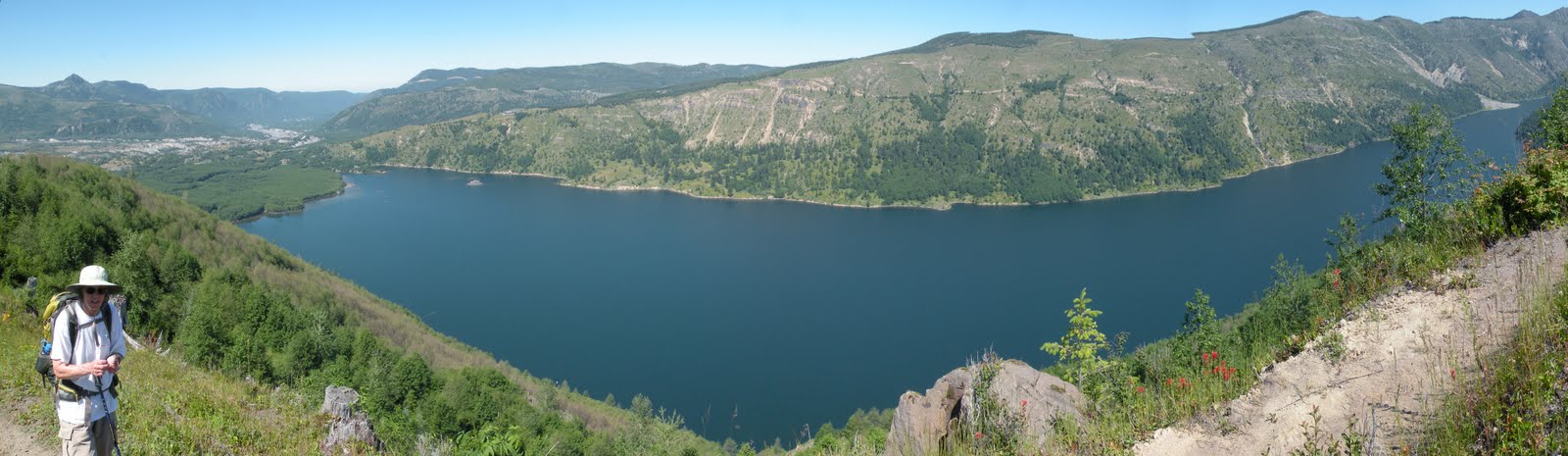
Now for the obligatory panorama. This is from Elk Rock view point, and gives a little sense of the scale of the area.


Thanks for checking out the blog. We'll try to be a little more frequent on our postings.


Wednesday, August 11, 2010

New Pergola is Finished!

Hello and welcome to our photoblog. I am taking a break from our pictures of France to show an update on our progress in the backyard. You may recall that last year we built a fence so that Angus would have a place to safely play. The photo below was taken after we completed the fence (but before we stained it). Believe me, that umbrella did not help much when it was 105 degrees last summer!


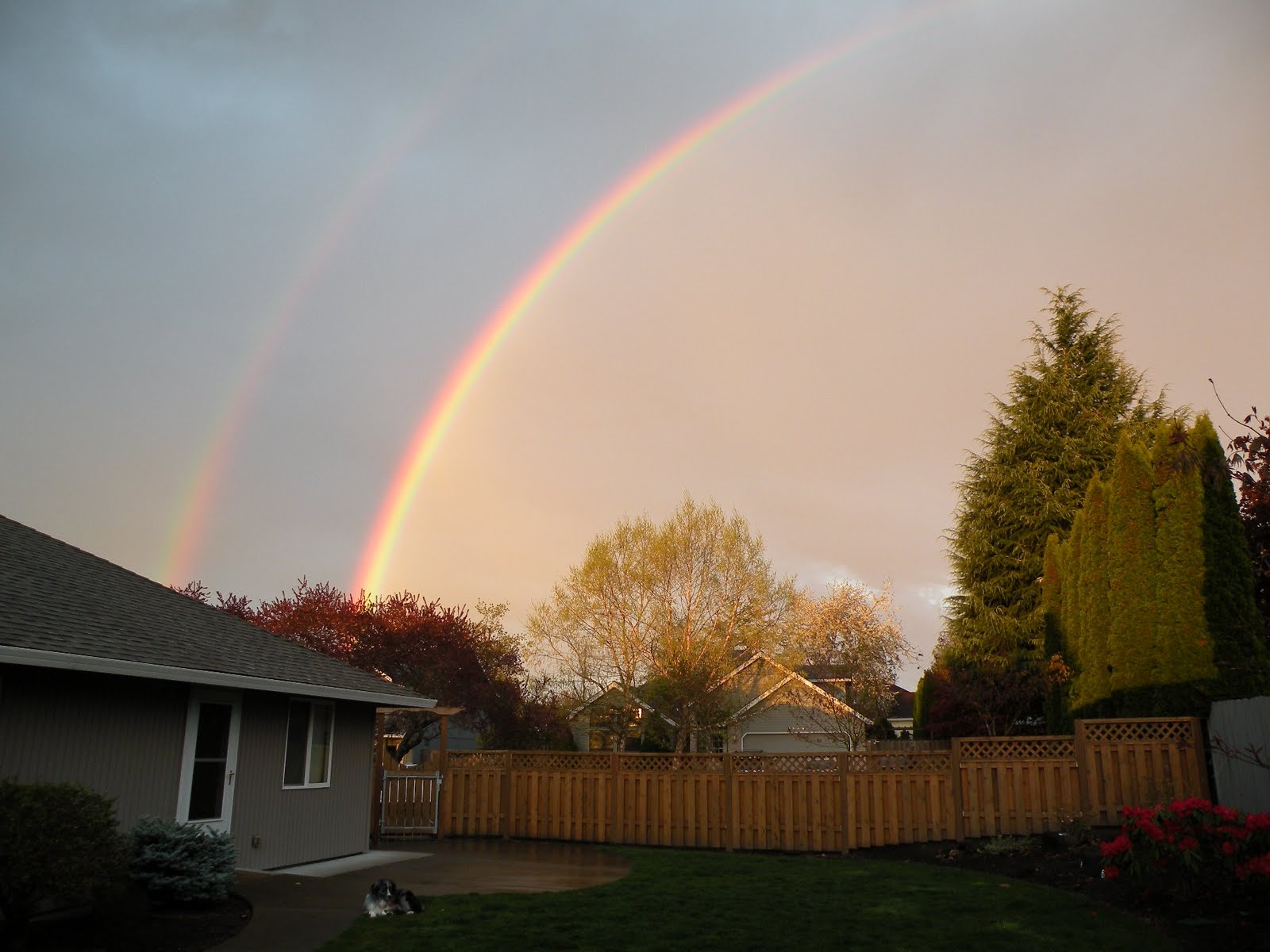
So our back patio looked pretty barren, as you can see below. Not much fun sitting out there at all, even with a double rainbow to enjoy. As you can tell, dogs have no sense of aesthetics. Angus is looking away from a tremendous view of a double rainbow. I guess if they can't pee on it, it doesn't interest them!

Over the winter, we spent a lot of time researching what we wanted to do in the backyard, and settled on building a pergola. We did a lot of designing and came up with a pretty good idea. So when Dad visited in May, we began our construction. We had a local company come in and set up the posts (which would have taken us a month - they did it in 2 hours). And after letting the concrete cure for a couple of weeks, we began building.

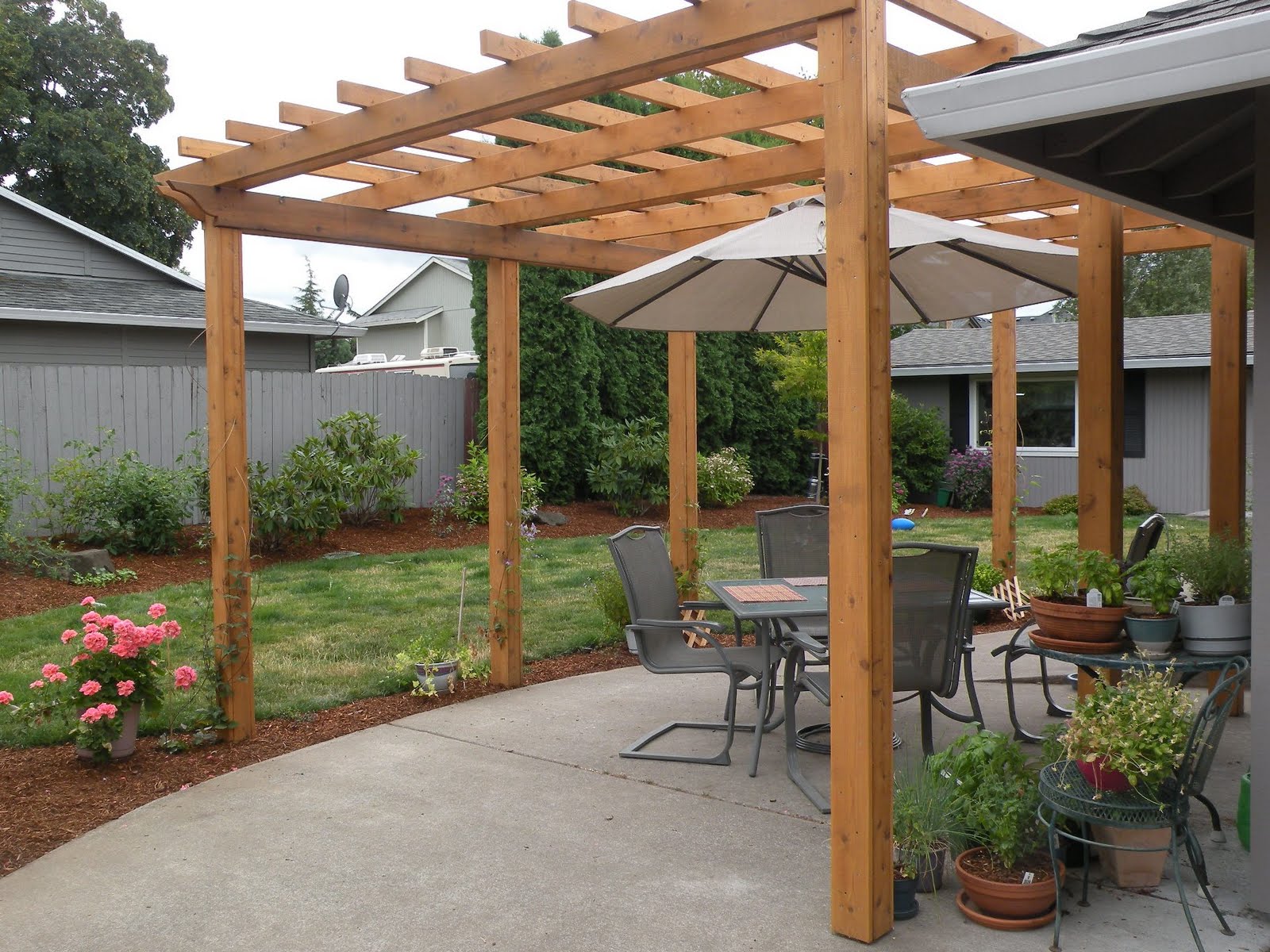
And we finally finished it a couple of weeks ago! It looks great! The small pieces of lattice at the posts are protecting some clematis plants from our over-enthusiastic dog when he is playing with Eba, his doggie girlfriend a couple of houses away.


We are very please with how it turned out. Until the clematis gets big enough to shade the patio (in 2 to 3 years), we can still open the umbrella under it.


We tried to match the design of the arbor when we built the pergola, so there is a consistency in the backyard. We also planted a jasmine to climb up the arbor.
Below, you can see that we are using brass and bronze welding rods to give the clematis something to climb on as they grow up the posts. We just drill a hole in the post at the lower end, then insert and bend the rod around the post until it goes where we want it to and drill another hole for the top end. The clematis just follow the rods up the post!


So nothing like celebrating the completion of a huge job! We had a neighborly get-together last Saturday evening (Aug 7th), with a fire for marshmallows and some great neighbors. Standing up in the blue shirt is Kathy Christiansen. She and Dan are our neighbors from across the street, and are the souls of hospitality and kindness. On the day we moved into our house, with boxes everywhere inside and 15 inches of snow outside, she came over and brought us a supper to welcome us. Seated to the left is Dave Cameron and his wife Mary Jo is seated to the right behind a post. They are Eba's owners (Eba is the brown dog behind Kathy), and Peter is the man standing beside Dave. He is a relative of Dave and Mary Jo's and is visiting for the Seattle to Canada bike ride that Mary Jo and Dave are going to do this weekend (Aug 12-15).


Kathy made this wonderful cake, called a "Midsummer Night's Dream" cake. It was unbelievably good! It took her two days to make it.


When you cut into it, you can see why! In the middle, there's a frozen layer of citrus "ice" that is so good. And the white icing is ice cream!


Even Dave, who normally doesn't eat dessert, cannot resist!


We are happy to have this job finished. Now it's onto the next backyard project, which is to re-landscape an area on the other side of the house so that we can put in some raised bed gardens this fall. Next year we plan to eat more of our own vegetables!
Thanks for reading and take care,
John & Annie


Saturday, June 19, 2010

France 3 - Chamonix

Welcome to our 3rd post on our trip to France. In this section of our trip to France, we took the TGV (Train a Grande Vitesse - which means "high speed train"), which was amazing. In 2007, one of the TGV trains was clocked at just over 350 mph. I don't thinnk we went that fast, but it was very fast. We took the TGV from Paris to Lyon, and then picked up normal trains up to the Chamonix area.

It was pretty cold and wet in Chamonix, as this trip was late September-early October. However, the clouds gave a beautiful atmosphere to the town. It is a definite "Alps" town with the appropriate architecture. We had a great room in a little "chalet", and just walked around the town. We went to a restaurant and had a fondue dinner, with raclette cheese which tripled our cholesterol numbers! It was so good, but so fattening!

Chamonix is nestled in a narrow valley between huge mountains on both sides of the valley. As you look down the valley, you see mountain after mountain fading off in the distance.

Another view of Chamonix in its valley.

We took a cable care up to the Aguille du Midi, about 3840 meters up. You could actually take a cable car all the way to Italy, across the top of the Mont Blanc Massif.

The Aguille du Midi.

If you go up to the top of the Aguille du Midi and look back at where the above picture was taken from, you see the picture below. The Alps are rugged!

NOTE: The picture below is NOT ours! I copied it from the Wikipedia article on Chamonix. So give credit where credit is due. It is a freely available picture taken by Paul Nash in March 2005. Thanks to Paul for making this photo available for the free use of anyone!

However, I wanted people to see what the valley of Chamonix looks like when the weather is nicer.

Thanks for reading. In our next blog, we go to Provence and the French Riviera.


Wednesday, June 16, 2010

France 2 - Paris

Hello and welcome to our second blog posting about our trip to France in 1999. We realize that the trip wasn't "recent", but we had a great time and wanted to post our photos so that friends and family could look at them in case they planned a trip to France. If you really want some great travel advice for visiting France (or anywhere else in Europe), please go to Rick Steves' website at: www.ricksteves.com, especially the Graffiti Wall. There is also a great section on travel in France.

We'll start with Paris, because that's where you need to start! We were in Paris for about 3 days at the beginning of the trip and about 3 days at the end of the trip. We have combined the photos from these two visits into one blog, so the last few photos in this blog were actually at the end of the trip.

First a note about France and speaking French. We do not speak French well. John has taken a couple of Conversational French classes back in the 1980s and periodically he goes back and reads some of his class material. However, if you are going to visit France, we urge you to take the time to learn a little bit of French. Be able to say a few phrases in French, such as Sil Vous Plait (please), merci (thank you), bonjour (good day), excusez moi (excuse me), and as much else as you can. This will make your visit much more enjoyable, both for you and your French hosts.

People often complain that the French and Parisians in particular are rude. We did not find that to be true. We think this is somewhat related to our attempt to communicate in their language, and to follow French customs. When you walk into a French business, say "Bonjour!" first, before you ask for anything. Don't just barge in and start demanding service. Take a little time and be sociable. Use "sil vous plait" and "merci" liberally. Try to ask for things in French. Almost all French people speak English MUCH better than we speak French. However, the French are justifiably proud of their beautiful language, and expect visitors to France to attempt to speak in French. We found that after a few sentences of our painful French, people would say "Actually, I do speak English!"

Enough travel advice! Onto Paris! In the first post, we mentioned that we had an overnight flight, and arrived about 6 am. We dropped our bags off at the hotel (we picked a small boutique hotel in the Marais area after reading other travelers' tips on the Rick Steves Graffiti Wall (see links above). We were too early to check in so we went back out and tried to tour Notre Dame. We were so sleepy, we were just sleeping standing up leaning on each other! Finally about noon, we gave up and went back to the hotel, checked in and slept for the rest of the afternoon and night.

The next few days, we went to the Louvre. We didn't go in, as we were limited in our time in Paris and we had tons of things we wanted to see. But we did stop for photos in front of the Pei Pyramid (below).

The amount of detail in the architecture in Europe is amazing. As you looked around the Louvre's walls, every inch of the walls was carved, adorned, or sculpted. None of the plain granite walls that you would see in Washington DC or other American cities. There are millions of stories behind all of these carvings and sculptures. It makes you wish that Robert Langdon (Tom Hank's character in the Dan Brown novels) was real and could take you around to explain what all of these things mean!


In the first post, we mentioned that we like to take boat trips in large cities. You can see below that the French love of beautiful public works extends to their infrastructure also. Even bridge columns are beautifully decorated.

On the boat trip, you got a great view of Notre Dame from the Seine river. You can really see the Rose Window at the end of the transept of the cathedral.


The Luxor Obelisk stands in the Place de la Concord. You can find a little history on this obelisk here. This obelisk is about 3300 years old, and was originally located at the entrance to the Luxor Temple in Luxor, Egypt. It sits on a pedestal which shows how the obelisk was moved from Egypt and erected in the Place de la Concord.

Of course, you can't go to Paris without seeing Napolean's Arc de Triomphe. To get a sense of the size of the Arc, look closely at the very top of the Arc in the picture below. You can see people standing between the crenellations at the top. This thing is big! It's big enough that a French pilot flew his plane through it after World War I in 1919.


When you are at the top, you have an unmatched view of Paris. 12 avenues converge at the Arc, and you can just stand and get a panoramic view of all of Paris. In the picture below, you are looking towards the Montmartre area (the setting for the moving "Amelie", which we highly recommend watching).


Of course, the real entertainment at the Arc is to watch the traffic going around it. In the picture below, only the outside cars are moving. Everyone else has stopped for a chat! When we were driving around in France, there were different rules for different roundabouts. In some, the cars that were already in the roundabout had the right of way and entering cars had to wait to enter. However, in others the cars that were entering the roundabout had the right of way and if you were already in the roundabout, you had to let other cars enter ahead of you!

You have to go up the Eiffel Tower, when in Paris. We went up late in the evening, so that it was dark by the time we got to the top. The sign on the Eiffel Tower in the picture below says "100 days before the Year 2000".

The rest of the pictures below are from the end of our trip. We visited the Musee d'Orsay, a fantastic art museum. The works of art are stunning, but the building itself rivals the artwork. There's a place where you can climb up to look out of the huge clock in the Musee d'Orsay to see the Louvre (below).


As we said before, the Museum is amazing. It's a converted railway station, and is stunningly beautiful.


Almost all of our lunches were picnics. Here, we are in the garden areas below the Eiffel Tower on our last day in France. It's strange, but one of the best places in Paris to get sandwiches are the tobacco shops (look for buildings named "Le Tabac"). They make some very good sandwiches!

Next, we will go to Chamonix, a small town in the French Alps where the first Winter Olympics were held in 1924.
Thanks for reading!